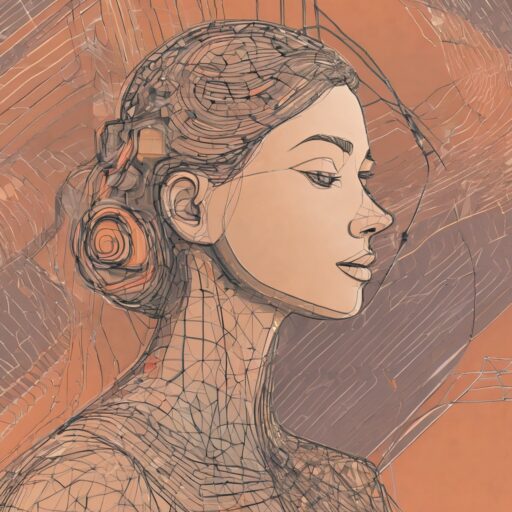
For most of the last century, architecture marched toward the plain. Ornament was stripped away, façades were flattened, and “less is more” became doctrine. But generative AI is quietly reopening a door that modernism tried to close — and one of the most striking beneficiaries is the lavish geometry of Art Deco.
Why ornament fell out of favour — and why AI brings it back
Decoration disappeared for practical reasons as much as ideological ones. Carved stone, cast bronze, and hand-laid mosaic were expensive and slow. A skyscraper covered in sunburst motifs and chevron reliefs demanded armies of craftspeople. Stripping the ornament away was, in part, simply cheaper.
Generative design changes that arithmetic. An AI model can produce hundreds of ornamental variations — friezes, grilles, spandrel panels, entrance surrounds — in the time it once took to sketch a single one. Suddenly the cost of imagining rich detail collapses, and the question shifts from “can we afford ornament?” to “which ornament serves the building best?”

What makes Art Deco a perfect match for generative tools
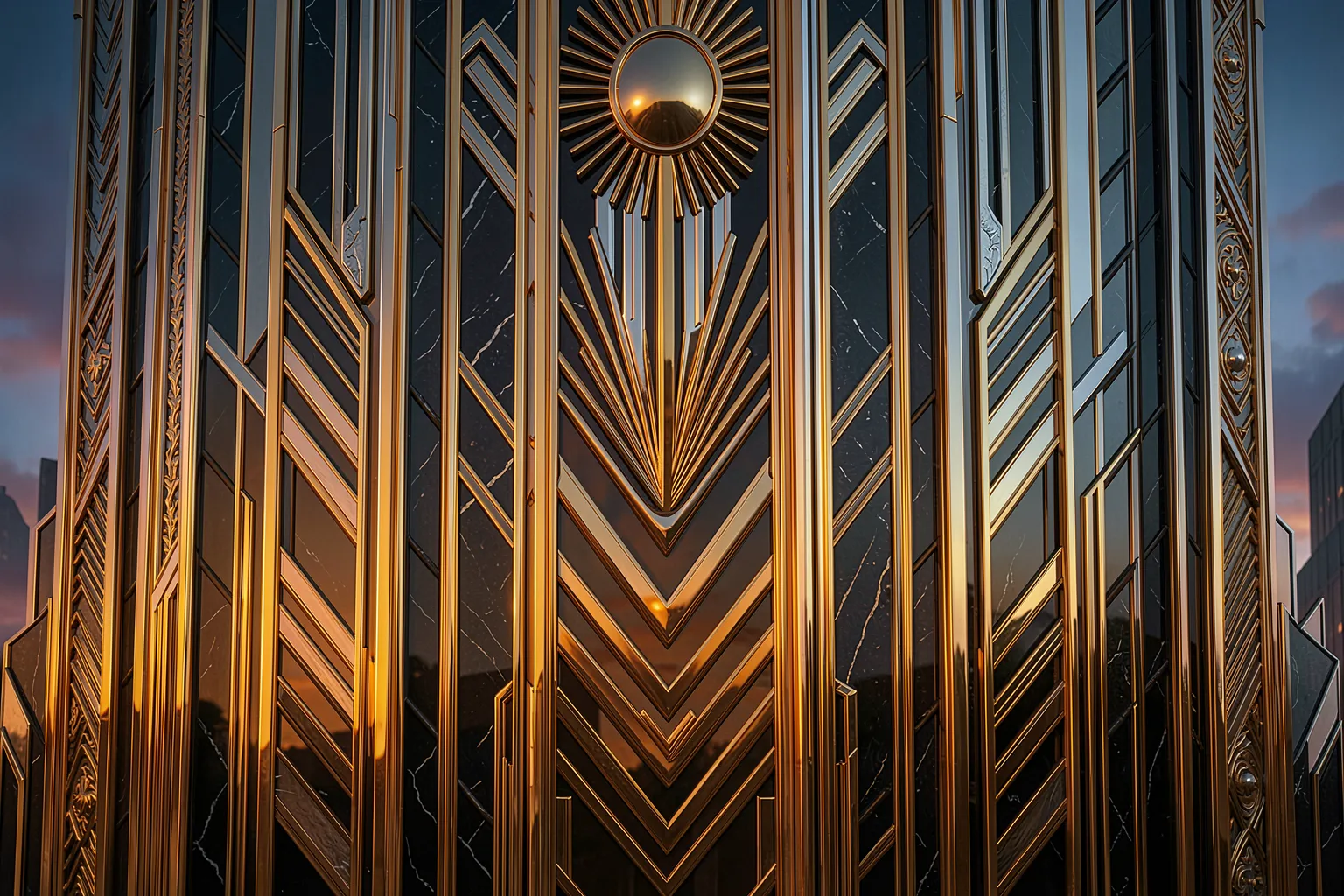
Art Deco is, at heart, a system of rules: bold symmetry, stepped setbacks, repeating geometric motifs, and a distinctive material palette of gold, chrome, black marble, and lacquer. That combination of strong structure and rich variation is exactly what generative models handle well.
- Sunburst and chevron motifs — parametric patterns that a model can scale, rotate, and recombine endlessly while keeping the family resemblance.
- Stepped, symmetrical massing — clear compositional logic that AI can extend into new façade proposals.
- Luxurious materiality — the interplay of polished metal and dark stone that gives Deco its drama, now easy to explore across dozens of lighting scenarios.
From revival to reinvention
The most interesting results are not straight copies of 1920s landmarks. They are hybrids: Deco discipline crossed with contemporary sustainability, digital fabrication, and forms that would have been impossible to draw by hand. A generative model can preserve the spirit of the style — the optimism, the verticality, the celebration of craft — while adapting it to today’s materials and structural realities.
This is where AI earns its place in the design studio. It is not replacing the architect’s judgement; it is expanding the vocabulary the architect gets to choose from. The taste, the editing, the decision about what actually gets built — that remains human.

A broader lesson for design styles
Art Deco is just one example. The same approach revives and remixes any style with a clear grammar — Bauhaus rigor, Brutalist mass, Art Nouveau’s organic curves, or the quiet restraint of Japanese design. Generative tools let designers treat history not as a museum but as a living library, ready to be reinterpreted for new contexts.
Explore it yourself
At AI Art Designer, exploring exactly these style crossovers is the whole point — open, generative systems for art, design, and architecture, with no artificial limits. Every image is generated with these tools and free to use, as long as you credit us. Ornament, it turns out, was never really gone. It was just waiting for the right tool to make it affordable again.
Want to see your favourite architectural style reimagined? Explore the AI Art Designer and start generating.