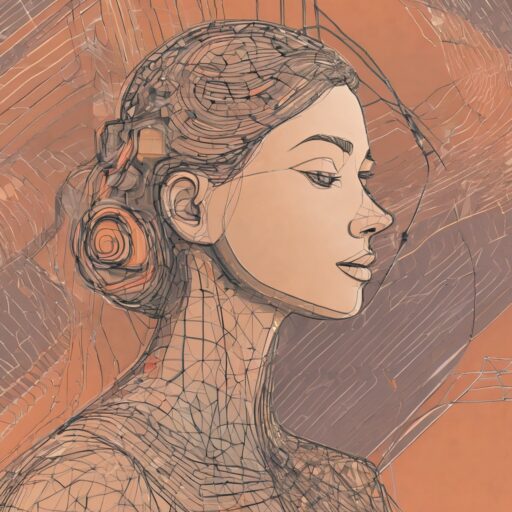
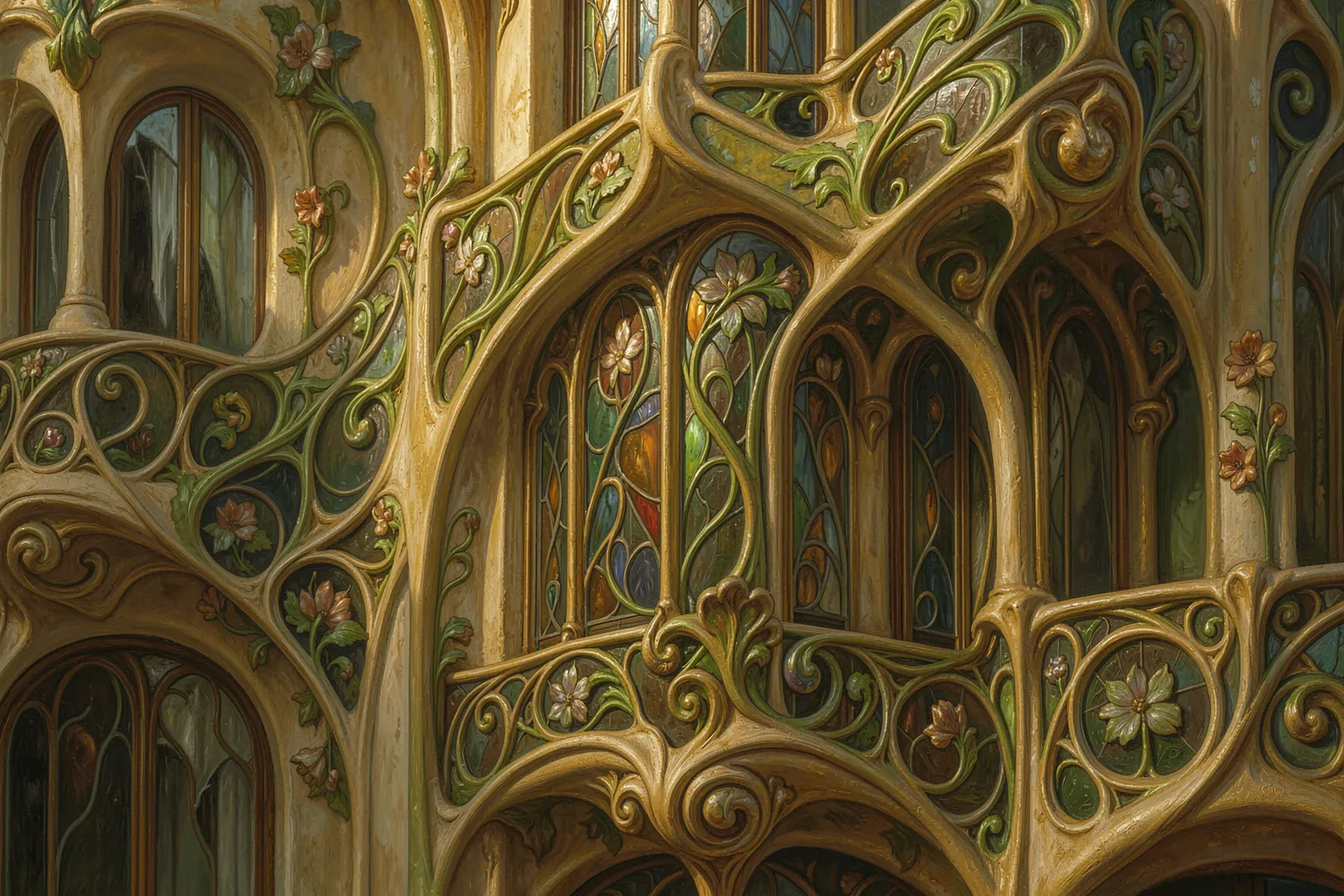
More than a century after Hector Guimard’s iron tendrils curled around the entrances of the Paris Métro, the most ornamental movement in modern design is having an unexpected second life — this time inside neural networks. Art Nouveau, with its whiplash curves, botanical motifs and refusal to separate structure from decoration, turns out to be a near-perfect subject for generative AI. Where Bauhaus prized the grid and Brutalism prized the mass, Art Nouveau prized the line: continuous, organic, impossible to mass-produce. That is exactly the kind of complexity a diffusion model loves to dream in.
Why Art Nouveau and AI Speak the Same Language
Art Nouveau was, in its own way, an early experiment in generative form. Its designers — Guimard, Victor Horta, Antoni Gaudí, Alphonse Mucha — treated the plant as an algorithm: a stem branches, a tendril spirals, a leaf repeats with variation. Nothing is quite symmetrical, yet everything belongs to the same growth logic. Modern image models are unusually good at reproducing that sensibility because they, too, work by recombining patterns rather than snapping to straight edges. Ask a model for „a doorway in the style of Horta“ and it will happily invent ironwork that never existed but feels historically plausible — hinges that flow into railings, glass that ripples like water.
The result is not restoration but reinterpretation. AI does not copy a specific Mucha panel; it internalizes the vocabulary — muted golds, haloed figures, ornamental borders — and then improvises. For a style built on the idea that beauty and utility should be inseparable, that improvisation feels less like forgery and more like a continuation of the original project.
From Facade to Floor Plan
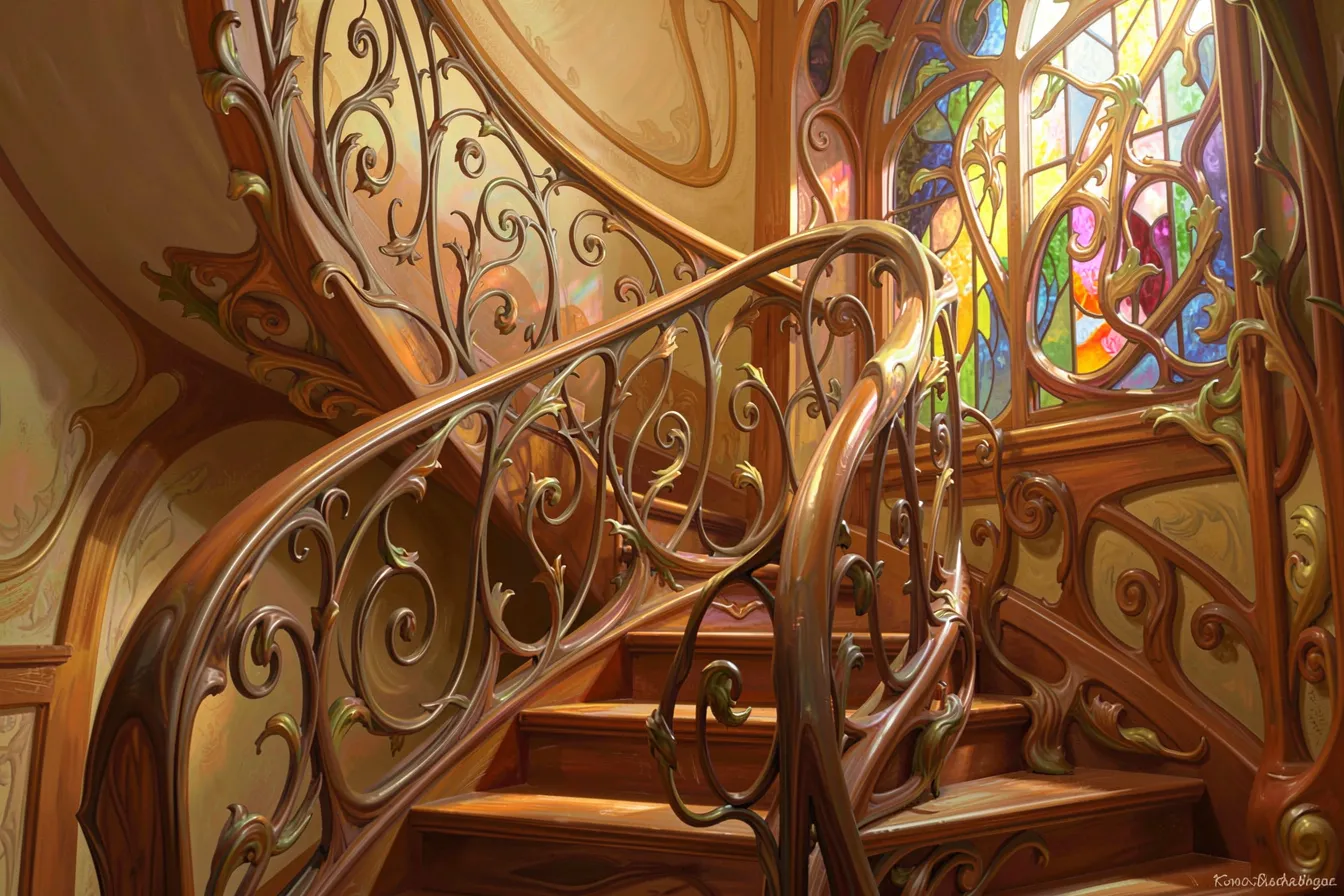
The revival is most striking in architecture and interiors, where designers use AI as a rapid ideation partner. A few prompts can produce dozens of variations on a stairwell balustrade, each with a different rhythm of curves, before a single line is drawn in CAD. Studios exploring the trend describe a familiar workflow:
- Mood generation: dozens of AI facades and interiors set the ornamental tone before any technical drawing begins.
- Motif extraction: recurring curves and floral forms are isolated and turned into reusable design elements.
- Material translation: AI renderings suggest where wrought iron, stained glass, carved wood or ceramic tile should carry the ornament.
- Contemporary restraint: the excess of 1900 is dialed back so a curved balcony or a single stained-glass transom reads as elegant rather than theatrical.
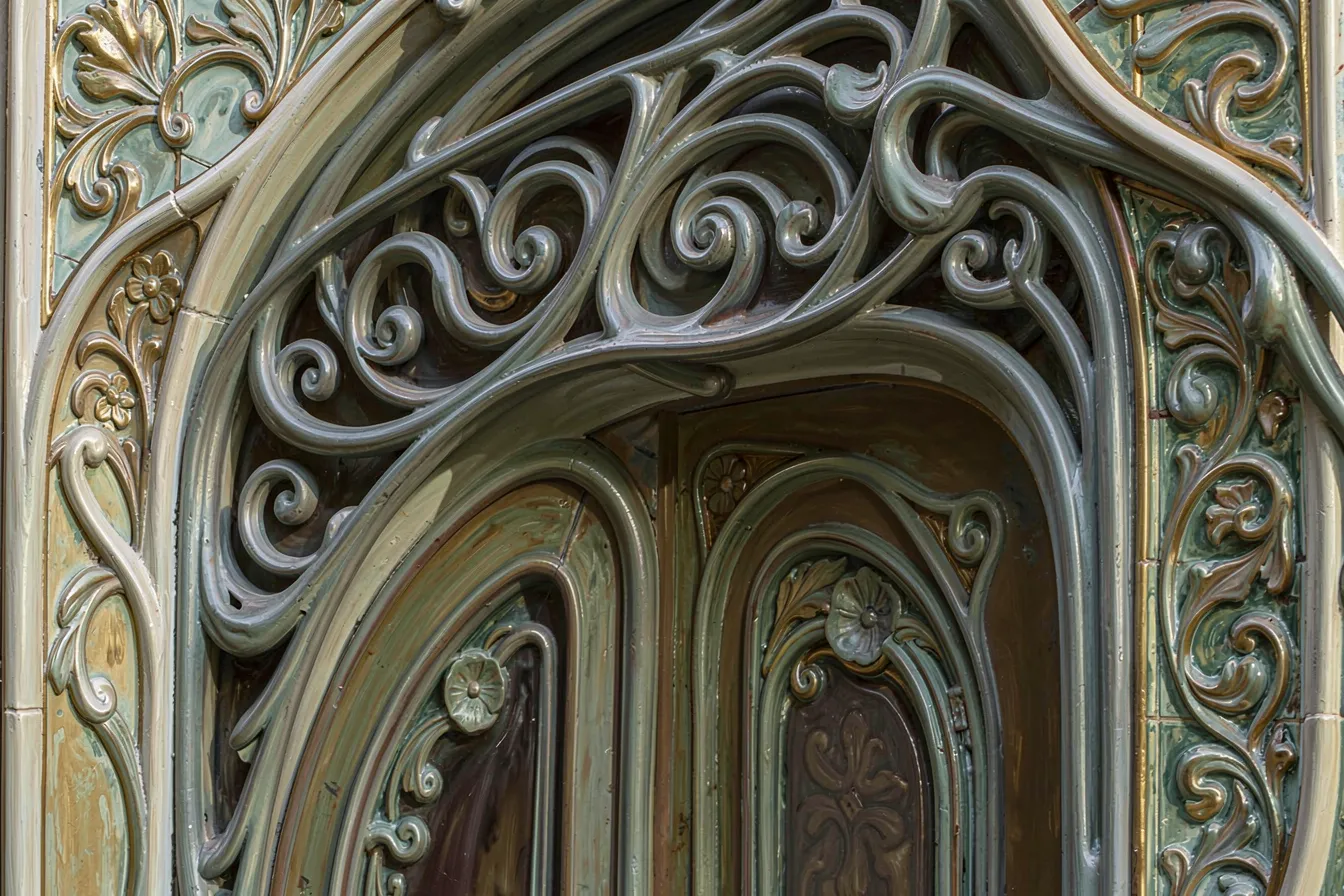
What makes this more than pastiche is the constraint. The best AI-assisted Art Nouveau does not smother a building in flourishes; it borrows one gesture — a doorway, a light fixture, a ceiling detail — and lets the rest stay quiet. The machine generates abundance, but the designer still edits toward taste.
The New Ornamentalists
For nearly a century, ornament carried a whiff of guilt. Adolf Loos famously equated it with crime, and modernism spent decades stripping buildings down to honest structure. Generative AI is quietly dissolving that taboo. When intricate detail costs a prompt instead of a master craftsman’s month, the economic argument against ornament weakens — and designers are rediscovering that people simply like curves, foliage and warmth. Art Nouveau, once dismissed as decadent, becomes a natural testing ground for a post-minimalist mood.
What Still Requires a Human Hand
The limits are as instructive as the possibilities. AI renderings routinely produce ironwork that could never be forged, glass that could never be cut, and cantilevers that would collapse under their own romance. A curve that looks effortless on screen may be brutally expensive to fabricate. This is where the human returns: translating a seductive image into buildable geometry, choosing which flourish survives contact with a budget, and ensuring the finished space serves the people inside it rather than the screenshot. The model proposes; the architect disposes.
There is also a deeper question of authorship that Art Nouveau, of all movements, makes vivid. It was born as a reaction against industrial sameness — a plea for the handmade in an age of the machine. Using the machine to revive it is a genuine paradox. The most convincing answer emerging from studios today is that AI is not the craftsman but the sketchbook: a way to think faster and stranger, with the actual craft still happening downstream in iron, wood and stone.
A Curve Worth Following
Art Nouveau failed commercially the first time partly because it was too expensive to make at scale. A century later, the tool that killed handcrafted ornament may be the one that brings it back — not identically, but in a form suited to how we build now. For anyone designing a home, a hotel lobby or a brand identity, it is one of the most rewarding styles to explore with generative tools: forgiving of experimentation, rich in reference, and endlessly variable.
Curious what your own space might look like with a little organic ornament? Explore AI-driven design styles and generate your own interpretations at ai-art-designer.de.